Tuesday, July 12, 2011

If IKEA made vlogs

I was all ready to give you a super cool sped-up video of walking through the Turkish market in Kreuzberg, but my camera, iMovie, and iPhoto are either non-existent or non-cooperative right now. I am beginning to think my laptop is allergic to video-editing software, but have yet to confirm my suspicions.

So, in the absence of a video, please listen to this song:

http://www.youtube.com/watch?v=pcawnRIyeok

while slowly looking through the pictures below, and pretend it's a sweet slideshow on Youtube. Imagine the captions as cool super-imposed text, and imagine the in between pictures and at the bottom as on its own slides according to the line breaks. Enjoy.


In our first week in Berlin we quickly discovered the city's different uses of space, from metropolitan centers to urban green spaces to places of public art.
Our new Galata Tower.
Urban farm in Mitte. Can you guess which "former" Berlin we're in, East or West?
Went to the river...
...and found another reminder of home! This was built by the same artist who made the hammering man outside of SAM.
At times Berlin had us convinced that it had never been divided. In our own neighborhood, we walked across what was previously the Berlin Wall "dead zone" without even knowing it until Tobi and Manuela pointed it out a few days into our time here. At other times, though, symbols of the city's torn and confusing past were startlingly clear.

Approaching the Soviet War Memorial with Tobi.
In addition to being a war memorial, it's also a mass grave: 2,500 anonymous Soviet soldiers are buried at this site.
An old Berlin Wall guard tower, at the entrance to the same park that holds the Soviet War Memorial.
"This was basically the Soviets saving the Nazis from the Nazis...history makes everything complicated," Tobi said.
Symbols of the city's future was equally clear at the Reichstag, where art displays and architecture paid homage to Germany's past while also highlighting its place as a key player in the political project that is the European Union.


Each boat represents a different part of the world, and together this represents their relations to each other. Throughout the year the boats are lowered, moved around, and sometimes even crash into the ground.
A new view of Berlin...
...from above.
More than sightseeing and touring, however, a typical day in the life of a UW Honors kid in Berlin sheds light on the city's past, how it does or does not remain on display, and how we negotiate and make sense of its symbols with our own Gramscian "inventories of traces" from home.

On any given day we'll go through Alexanderplatz...
...to Humboldt...
...and eventually back to our neighborhood of Mitte and Kreuzberg--which is almost like going back, even further, to Istanbul.

The new symbols and landmarks we associate with coming, going, home, and place mix among images of Seattle, Istanbul, and Berlin, until each new image seems to find a root in another that came before it.

Galata Tower is the Space Needle, or the TV tower at Alexanderplatz.

Kreuzberg is the I-90 bridge.

The stained glass at Humboldt is Red Square.

The apartments in Mitte are the World House Hostel. Oranienstrasse is the "walking street."

Some images, however, stand alone. The Soviet War Memorial, the Hagia Sophia, the Berlin Wall are all singularly there.

And us? We are here.


And there you go--rapid overview of Week 1 in Berlin. Cheers!

Sunday, July 10, 2011

eelitz-Bay eilstatten-Hay

(Warning: This blog post is quite long. I will never post anything approaching this length ever again. But, we had an epic day. It deserves equally ridiculous documentation.)

My roommate (and gifted photographer) Cathy is really into urban exploring. That means going to abandoned places you're generally not supposed to go to, taking in forgotten architectural and historical wonders, and leaving them as you found them. This generally involves trespassing, which is bad--but hey, we don't read German, so we weren't sure exactly what those signs at the gate said, anyway.

Now, let's start at the beginning. After Cathy stopped and grabbed a sandwich at a nearby bakery, we found out very quickly that we don't actually know how to read the German subway map, so it took us a few tries to find the train station. When we did get there, we found out that we also have no idea how to buy a train ticket. Luckily, an exceedingly friendly old German man with comprehensive knowledge of the subway system was hanging out by the ticket machine, seemingly for the sole purpose of helping people buy their tickets. He helped us buy tickets, determine the correct platform, and find the correct platform, and then gave us a map and a time schedule with our destination, departure time, and arrival time underlined. I was bowled over by his apparent pride in his city and his willingness to help weird incompetent American girls asking how to get to a creepy old hospital in the middle of nowhere. There's no way we would have figured it out without this guy.

So, we settled down to wait the thirty minutes or so for the next train.
When we got off at our stop about 45 minutes later, we were greeted by an abandoned, boarded up train station (behind which there was a large abandoned house), a pine forest, and a large road. From some limited Google Maps research the night before, we figured we should head south on this road to hit the complex. It didn't take long--in less than a quarter mile we were seeing large, factory-like buildings like this

and overgrown old houses like this
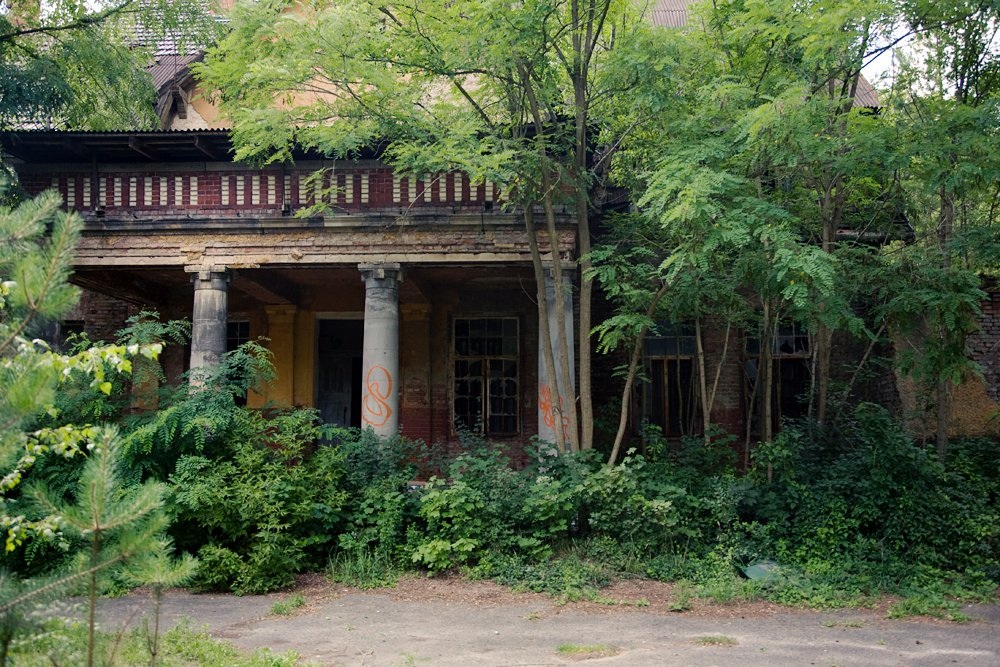
right up against the main road, connected by old paved roads and walkways. They were all abandoned, and mostly boarded up. Those that weren't boarded up (or, weren't very well boarded up) were pretty trashed inside. As we kept walking we saw more mansions, shacks, pumphouses, and factory buildings seemingly at every turn. It felt like a ghost town.

By now you might be wondering, what exactly is this ghost town? The history behind this abandoned Soviet hospital and training complex is staggering. The site was first developed in 1898 as a tuberculosis sanatorium. During the First World War it served as a military hospital for the Imperial Germany Army, treating the earliest causalities of new technologies like machines guns and mustard gas. A young Adolf Hitler recuperated there in the fall of 1916 after being blinded by a British gas attack and wounded in the leg at the Battle of Somme. (This earned him the Iron Cross, and he later wrote about his stay at the sanatorium in Mein Kampf.) The site was again used as a military hospital, this time for wounded Nazis, during World War II. By this time, the complex had grown to include over sixty buildings.
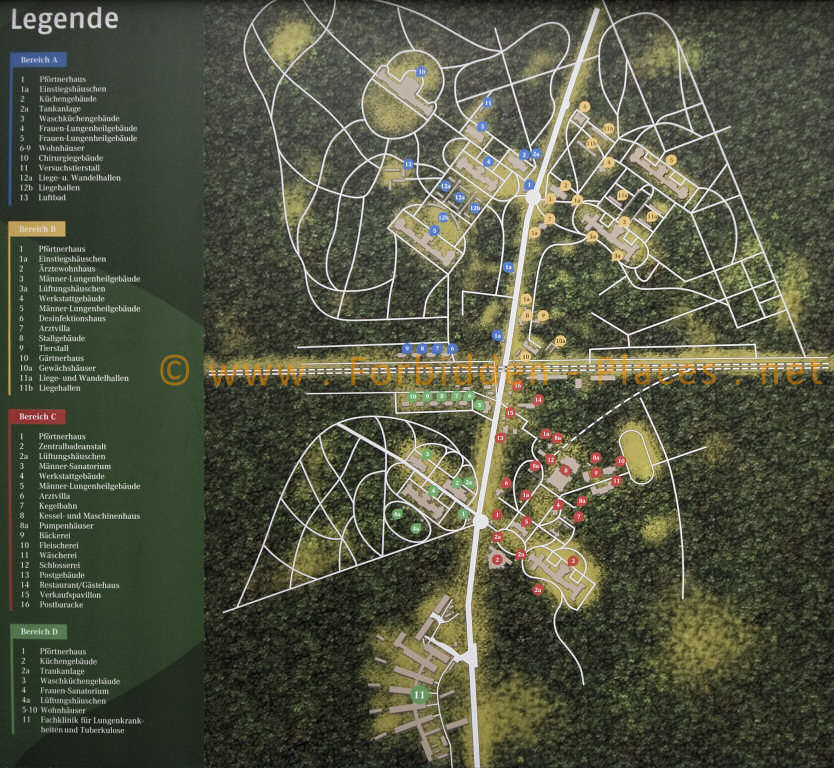
You can see the train tracks running horizontally through the middle of this map. Cathy and I only got to ten or twelve buildings in the lower right color-coded-red section.
In 1945 the complex was occupied by Soviet forces, and remained a Soviet military hospital until 1995, well after the reunification. The hospital under Soviet control treated several Communist party members, included disgraced head of the GDR Erich Honecker, who went to eelitz-Bay eilstatten-Hay in December 1990 after having been forced to resign.

In the years since the Soviets peaced it in 1995, several attempts to privatize the site have failed. Today, some sections remain in operation (like a small neurological research and rehabilitation center, as well as a center for research and care for victims of Parkinsons disease). A majority of the complex, however, has been abandoned and unsecured since at least 2000.

Things got really exciting when Cathy and I reached a grassy square enclosed by ornate (and very thoroughly boarded up) buildings on three sides, with this statue in the center:
"To the heroes of the Soviet Union." Yeah, Cathy reads Russian. Awesome.
Right about now we saw some hipsters walking down the road toward one of the buildings (We later figured out this is the building marked with a red #3 on the map--the biggest building there!!) looking like they knew where they were going, so we followed. We watched as Tall Skinny Male Hipster hopped onto a ledge, pulled at some nails (they were just bent over, rather than nailed into, the boarding), and took the boarding off of a 2'x2' window. Success! We joined the hipsters and climbed through the ridiculously tiny window. This is what we saw inside:
The flower-shaped window looks out onto the square with the Soviet memorial statue.
From the stage looking toward the rest of the building. The door on the right leads to the more hospital-y parts. Note: The Soviets probably did not paint that giant lizard. That said, the lizard was one of probably three or four significant pieces of graffiti we found. Wow.
Our best guess was that this was some kind of exercise hall or gymnasium. On our way in we also found a script, a set plan, and a call sheet for the movie Street Dance 2 3D from early June, 2011--just a month ago! Apparently the producers of the movie were shooting a steamy Paris dance club scene in this hall. When this greatly anticipated cinematic masterpiece comes out, it will join the likes of The Pianist as a film that shot at Bee-lits Hile-stat-in. Cathy and I will surely be first in line to see it.

The original Soviet artwork was all around the walls--paintings and murals of runners, weight-lifters, riflemen, basketball players, gymnasts, a few Olympic torches. We even found a cyclist!
You can buy CCCP  jerseys like the ones they wore in the 1980 Olympics on eBay. So ironic.
Cathy translated this as "master candidates of sport."
After frolicking around in this room (because, obviously, it was made for frolicking), we continued into the rest of the building. We were stopped by this silly door with this silly lock and this silly missing windowpane. The Tall Skinny Hipsters made it through no problem, and I managed to squeeze through as well, but Cathy is so tall (5'10''!) that she couldn't make it through.
Awkward.
No way were we going to separate, and no way were we going to turn back! We'd only seen about 1% of this ginormous building, and the creepy hospital rooms, grand staircase, and other treasures were just beyond this door. Besides, Cathy's the one with the camera skills, so it was more important to get her in to see all the good stuff. We left the building and started walking around it to try to find another way in. While we were walking we met a English-, French-, German-, and Russian-speaking film crew from Berlin who were scouting locations for their next movie and looking for a way in, as well. Now we felt really badass, because we got to be all like, "Oh yeah, we know the way in. We can show you. Yeah, it's pretty hard to find, no big deal." We couldn't find any other open/poorly boarded up windows, so we went back to the entrance into the gymnasium hall with the filmmakers. Once again, we ended up at the dead-end door. This time we had big strong filmmaker men with us (as opposed to Tall Skinny Hipsters), and they tried to lift the door off its hinges. Then I found a crowbar (or something) and started removing nails with it, and then they borrowed the crowbar to try to bend an open chain link on the lock chain...but all to no avail.

I may or may not have been serious when I proposed we just kick the door loose and pry it open at the hinges with my super awesome rusted crow bar-like thing.
In retrospect, the chain-busting route was probably a bit more reasonable. And much more respectful. I guess I was just in that Soviet gymnasium mindset of WINNING THINGS!
This thing was solid. Luckily, just as we were about to give up and leave, we saw a new group of hipsters on the other side of the door. One of the filmmakers asked them in German how they got there. They told us about a slightly hidden staircase back by the gymnasium that would take us up to the second floor and, from there, give us access to the rest of the building. We found the staircase easily (how did we miss it??)  and went to town. We spent the next hour or two exploring the four floors of this gorgeous building with our jolly filmmaker friends (one of whom had impeccable English and a great sense of humor), and still only managed to get to about a third of it.
Secret staircase!
First dose of unobstructed sunlight.
An upstairs hallway. All of the rooms off the hallways that we went into were empty--whatever furniture was once there was taken long ago.
Golden room.
I know, a lot of staircases and hallways--but they, along with the open windows on the upper floors (only the ground floor windows were boarded up), were so much of what was so beautiful about this place.
The infamous blue staircase, about which many an urban explorer blogger blogged before us! There was just about no tagging anywhere, though. Just five layers of peeling paint.

From the top of the staircase.
All was going well, until we went to the first floor and into a large hall adjacent to the bottom of the staircase, in the first photo below. A typical horror movie scenario began to unfold. First, some of the crew, feeling ill, went back to their car. Then, our remaining jolly English-speaking film-making friend remarked that his cell phone had no service. Then, Cathy and I found the very strange tiled room below. This bath/shower room was pristine. Shining, even. Everything around it was wrecked and dirty and trashed--compare it to the photo (of the hall that we found it in) above it. WTF?? Then, jolly filmmaker said that he was going to go join their friends after all, since he was unable to receive any calls and they might be trying to get to him--"ciao!" Just like that. Bam bam bam.

As soon as he left it got very quiet, and very cavernous. This guy had been so light, kind, cheerful, and knowledgeable, and, without him, the building--especially the darker first floor--suddenly felt very uncomfortable.
A slight change of scenery from the top floors.
"Uhhh...Cathy...come check this out. It's, uh, really clean."
We saw this room right across the hall from the tiled room and picked up our pace...but not, of course, before shooting a couple frames!
And we were off. We hung out in the Soviet gymnasium and played around and took some more pictures, and then checked the perimeter of the other two large buildings in the square to see if we could find any way inside those. We didn't find anything, but we DID see this cool sign in one of the windows:
Cathy translated this for us: it's a chart of poisonous substances that "the enemy" may use, accompanied by their treatments. Neat-o!
Now it was getting close to 7PM, and we were both pretty hungry, so we headed back to the road and the train station. Is the adventure over now, you may ask? Of course not! We still have like four items to fit into this ridiculous story line. On our way back we passed a house that this couple has renovated and now lives in, mere yards away from a dozen creepy abandoned houses and buildings. They were sitting out in front in white lawn chairs, drinking juice out of a nice pitcher and reading the paper. Weird. They also had a very friendly kitty cat, who we stopped to play with.
Look at the little faaaace.
On the train we entertained ourselves by reading the Street Dance 2 3D script. We also saw a rainbow.

Back in Berlin at Alexanderplatz, we were standing there, minding our own business waiting for the U8, when these men wearing shorts, singing "Lucy in the Sky with Diamonds," and carrying a very large kiwi tree branch showed up on the platform. Cathy's project includes taking portraits on Berliners, so she asked if we could take their picture. The darker-haired one gave us his email address so we could send him the pictures later.
Hahaha.
HAHAHAHA.
They got on the same car that we did, and they got a lot of funny looks from everyone else on the already very crowded car. They spoke excellent English, and talked to us for a while. Before we got off the train the lighter-haired one handed us these little green cardboard packets with Japanese all over them and instructed us to not open them until we got back to Seattle, and to send them an email when we did.

Naturally, I opened mine the second we got off the train. It was a Popet. (See http://www.eurobiz.jp/content/2010/april/columns/green-biz and prepare to get your mind blown.) Huh.

Now, my astute and devoted reader, the adventure must be over. We've covered all 10 terms, you say! This blog post has gone on forever! I am beginning to question reality! I know, I know. Give me just this one last thing. We looked up the darker-haired guy's email address this morning, and, lo and behold, he is an INTERNATIONAL MALE MODEL. He is what Tyra Banks might call "fierce." With some light Internet stalking we found out he recently got back from a shoot in Sidney. And he's in all these high fashion magazines. And he gave me a Japanese recycling bag shaped like a teddy bear. Awesome.

So, that's the story. That's what I did with my Saturday. Thank you, people and places of the greater Berlin area, for quite a day.

Saturday, July 9, 2011

One of these things is not like the other

1. exceedingly friendly old German man with comprehensive knowledge of Berlin's public transportation system
2. rainbow
3. friendly kitty cat
4. hipsters
5. English-, French-, German-, and Russian-speaking film crew from Berlin
6. sandwich
7. abandoned Soviet hospital and training complex
8. kiwi tree
9. Popet (i.e., a trash bag shaped like a teddy bear that's all the rage in Japan)
10. Street Dance 2 3D

Puzzled? So was I. Stay tuned for the full story that connects all of these ridiculous things into one single eight-hour-long German adventure!

Thursday, July 7, 2011

Out of place

I've never had a travel experience in which I have felt completely without a language. In Thonon, I spoke a good amount of French and had a host family to act as the buffer between me and the outside world. In Tijuana, I knew enough Spanish to get by and was able to speak with actions. In Beijing and Zheng Zhou, I was with a group of musicians, and people seemed to like our music enough that they didn't seem to care what language it was in. And in Belfast...well, they speak English.

In Istanbul and Berlin, though, not only do I not speak the language, I neither have connections (like a host family) nor make contributions (like building a house or sharing music) with which to create meaningful interactions. The language difference was more pronounced for me in Istanbul, where I stood out as an American and was almost always addressed in English. Even in Berlin, where I blend in a little more and people generally assume I speak German, I feel very out of place. My presence doesn't feel very constructive to the places in which I find myself, so I have trouble seeing how I am an acting part of these places.

A night or two ago, at the cafe near our apartments, this out-of-place-ness was more pronounced ever--but also more fun than ever. I went to the cafe all ready for some quality homework-doing, Husky-Cycling-website-writing, gmail-chatting-with-my-bff-Kamila time, but when I got there the quiet little cafe that I had gone to on Sunday night with my roommates was now THE SCENE. By the time I got my drink there wasn't a single free table, and the crowd around the bar was out the door. It wasn't crazy or rowdy or anything--just totally hoppin'. I was the only one there alone, and definitely the only one doing homework. I must have looked very out of place with a laptop and photo-copied reading pages on the table instead of beers and margaritas and fancy appetizers. Imagine a college kid being all studious on a Mac in the middle of, I dunno...a super trendy bar in Capitol Hill. I'm imagining The Saint, but take your pick. Now, make me the studious college kid, and put the bar in Berlin. Yup.

Nevertheless, I came for my free wifi, and nothing keeps Gennie Gebhart from some good free wifi. So I stayed for an hour or two. Some German ladies sat at the other half of my table, someone asked if I was using the chair across from me (nein), and, as things got crazier, a waitress came over and asked me if I could move my/the German ladies' table over so they could fit in another one next to us--all in German! Whoa. As awkward as I felt, all of these little micro-encounters were actually kind of fun. I felt like I saw more of the neighborhood than I would have if I had been walking around or on a tour. And, now I know--Wednesday night is THE night, and this cafe THE place to be on Wednesday nights, in Mitte.

I kept on truckin' with my mundane, more-appropriate-for-a-quiet-Starbucks-in-the-afternoon-than-for-a-cafe-in-Berlin-that-serves-liquor tasks, until a guy with dreads down to his butt came over and gestured to my tea and my menu and asked me something in German. I just shrugged--maybe he wanted to know what kind of tea I'd gotten? Regardless, I took this to be a good sign that the hipster barometer was getting low. (Get it? Get it???!? It's like there was a hipster storm coming!!) So, I packed up my Seattleite cafe gear (if only I'd had a North Face and a Nalgene) and headed back to the apartments--which is where I am now. Now that I think about it, if you turn around a few times and squint real hard and don't read the labels on anything in the kitchen, our apartment could totally be somewhere on 45th and Roosevelt...

Tuesday, July 5, 2011

Thank you, Eurosport...

...for the live Tour de France coverage!! Before you know it I'll be talking cycling tactics in German. For now, I've only gotten as far as saying the names of riders and French cities in a very convincing (if I do say so myself) German accent.

Sunday, July 3, 2011

Visual, writing assignment #1

See the assignment instructions here:
http://uwhonorsinberlin2011.blogspot.com/2011/06/visual-assignment-plus-writing.html

Images:
Photo 1 - Armani ad in Ataturk airport. This is a case of how I see determining what I see: what I perceived as a dissonance between the model's headscarf and the international consumption and wealth Armani represents crystallized the model as the "other," and made this image seem strange and contradictory to me. Tourist alert when I whipped out my camera and took a few pictures of this - who else would take pictures of a regular ad?

Photo 2 - We saw kids playing in these streets safely, "treating the urban as if it is rural," Orhan said. The space is built as and for a city, yet we saw the people who live there treating and moving within it as a rural space.
Photo 3 - When I look at this I see a camera-produced image, not what the site actually looked like on the ground. This does not convey what I felt like on the ground, either. I don't know if any one image could express my relationship (or, frequently, lack thereof) with my religion--or with any religion, for that matter.
Photo 4 - Kripoe's "yellow fist" street art undoes the west/non-west binary. (In other words, he really gets around.)
http://allcitystreetart.com/2011/04/26/raised-fist-turkish-street-art-from-kripoe-invader-and-more/
http://www.tripleman.com/index.php?showimage=785
http://www.tripleman.com/index.php?showimage=786

Photo 5 - Food, gifts, consumption - all deeply personal themes. Photography is appropriate for a memory like this one, which I associate not primarily with smell, sound, or even taste, but with the moment in which I started my day by seeing these colors and textures. Now that we've left Istanbul, though, this photo is, in Ozyurek's words, "a mere replacement for something lost."
Photo 6.1 - Istanbul is not the "old city," understood via architecture.
Photo 6.2 - Istanbul is not the "old city," understood via bodies.
Photo 7 - Evidence of political and social turmoil in Turkey's neighboring countries, found in unexpected places.

Related blog posting, 7/2/11:

In the introduction to The Politics of Public Memory in Turkey, Esra Ozyurek remarks, “the foundation of a nation-state is commonly a traumatic experience because it brings a rupture with the past" (11, emphasis mine). We heard about the traumatic episodes characteristic of the rupture that was the founding of the Turkish Republic—massacre of Armenians, deportation of Orthodox Christians, the wealth tax, the ban on fezzes, overhauls of traditional alphabet and calendar systems—in Jen's lecture and tour. Later in the week, Orhan instructed the group to throw away the misconception that any part of Istanbul is the "old city." He articulated the effects of these experiences of rupture in terms of the built environment, and prepared us to see this rupture as we moved independently around the city. Walking around Istanbul, difference in the built environment—“ancient” mosques and monuments right next door to gentrified apartment complexes, like those in the view from the Istanbul Modern parking lot in Photo 6.1—is apparent at every turn. This image in particular brought to my mind what Ozyurek calls a "site of forgetting," which retains for the observer "a residual sense of rupture...to prove that the break actually took place" (6). In the aftermath of rupture, the gentrification that Orhan  showed us hides violence, dictating what a citizen sees and ultimately remembers.

After Orhan's lecture, I started to see how the difference between "old" and "new" in the built environment translates onto people. Capitalism is at the center of my train of thought here: nostalgia for "old" times and practices in the face of gentrification "runs the country of which it is part...[and] is quite successful in turning commonly shared objects, concepts, and spaces into commodities" (Ozyurek 10). The glorifying of "Ottoman" foods, styles, and artifacts presents a flip-side to the traumatic experiences of the founding of the nation-state that Jen presented. Ottoman practices were previously abolished in the name of an imagined "Turkishness," but now the powerful longing of nostalgia (Tugal 161) has made those same practices opportunities not just for the construction of identity but also for capitalistic gain. With these ideas in mind, Photo 6.2, of Taksim Square during rush hour, is a meditation on the "engines of capitalism" (Ozyurek 10) in which the people of Istanbul and their nostalgia are simultaneously caught. The image of the woman in the foreground, with her back turned to the camera and her head covered, overlaps with other images and texts I encountered in Istanbul: first, the Armani ad in Photo 1, and second, Ozyurek's description of state-sponsored posters at the turn of the twentieth century that compared veiling practices with new, modern city states in an effort to "remind citizens of what they should leave behind and forget about desiring" while simultaneously "preventing the old ways from totally disappearing" (6). So, this image leaves me asking: to what extent is this woman “old” or “new”? Do her stylish black leggings and trendy belt “cancel out” her headscarf and skin-covering outfit? Or, is the contrast between the two styles—in people and in the built environment—indicative of a unique negotiation of modern Turkishness?

Finally, Photo 7 requires a short back-story. Janelle, Elizabeth, and I met two Turkish guys, Omer (pictured) and Can, on the main street north of Galata on Wednesday night. We didn’t speak any Turkish and they didn’t speak much English, but it seemed more fun to hang out around (but, note, not really “with) attractive Turkish guys than with other Americans. We managed to ask them where they were from, and Omer responded that he was from Bosnia. I didn’t think anything of it. The next day, however, when Didem lectured on the ongoing political and social turmoil in Turkey’s neighboring regions, the surprising significance of getting drinks with Omer clicked. I have no way of knowing if he and his family migrated in the 1990s to escape the wars, or if they came at another time for another reason. Regardless, meeting a self-identified Bosnian in Istanbul prompted personal revelations on the place of migrations from the Balkans in shaping my social circles. One of my good friends at home came to the U.S. from Serbia in the early 1990s with her family, and I have never really admitted to myself that she was part of a larger movement of people. As my close friend, she is, to me, so much more vibrant and tangible than numbers in textbooks or even in Didem's lecture. I see her as somehow immune to the conditions of migration, because I perceive her instead as part of my normal, everyday life. The coincidence of meeting a new person in Istanbul one day and confronting the (possible) reality of that person's introduction into my life the next has forced me to interrogate the ways in which I protect myself from the realities of the friends and acquaintances that make up my social world and, indirectly, my own identity.

Friday, July 1, 2011

The Sema

We made it!


We saw fireworks by the suspension bridge on the walk back to the hostel across the Galata Bridge, and then it started pouring rain when we got to the tower. How fitting. :)

Bring the pure wine of love and freedom.
But sir, a tornado is coming.
More wine, we'll teach this storm
A thing or two about whirling.

      - Jalal ad-Din Rumi (trans. Shahram Shiva)